
Hyve Data in the Room: Idaho Hospital Association Brings Payer Performance to State Lawmakers
Empowering healthcare providers with collective intelligence to transform the future of healthcare.

At Hyve, we talk about our mission every day. It's something else to watch it play out in real life, and that's what happened on October 14, 2026, in Boise.
Idaho Hospital Association President and CEO Brian Whitlock presented to the Idaho Health Insurers Working Group, an interim legislative committee, and used Vitality Payer Scorecard™ data to show lawmakers how payer performance plays out for Idaho hospitals.
IHA represents all 51 community hospitals in Idaho, serving patients across every payer type. Whitlock's central point was direct. Administrative burden isn't a back-office issue. It reduces access to care.
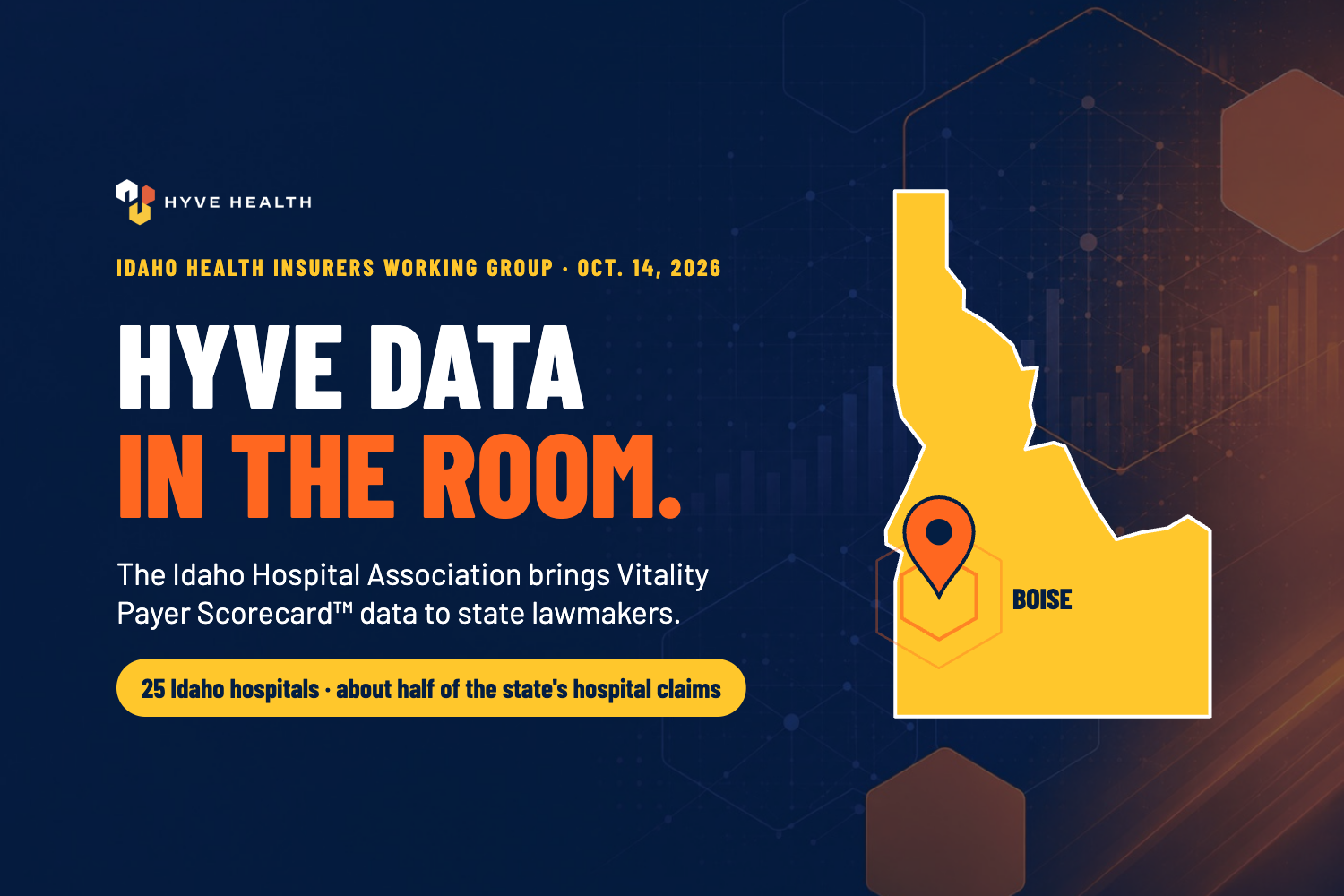
The Vitality Payer Scorecard™ benchmarks payer performance using remit data sourced directly from hospitals. In Idaho, 25 hospitals representing about half of all hospital claims in the state are enrolled, and three more are onboarding. Seeing that data inform a statewide policy conversation is exactly what it was built for.
Whitlock described its purpose to the committee this way:
"The purpose is to identify payer behavior, benchmark performance, and provide quantitative evidence to support operational improvement and healthcare advocacy efforts, the very things that this working group has been tasked with."
Brian Whitlock, President and CEO, Idaho Hospital Association
What the data shows
Statewide, Idaho payers perform better than the national benchmark on all three headline measures IHA presented, based on 12 months of discharges through May 2026 and remits paid through August 2026:
- Prompt pay: 13.6 days in Idaho vs. 14.6 days nationally
- First pass yield: 92.3% in Idaho vs. 86.6% nationally
- Denials by dollar value: 5.0% in Idaho vs. 6.9% nationally
That's a credit to how payers and hospitals in Idaho work together. But a statewide average can hide who carries the burden, and in Idaho, it's rural hospitals.
The Vitality data IHA presented also showed that rural hospitals:
- Wait an average of 60 days for delayed clean claims to be paid, compared with 54 days for urban hospitals
- Face a 40% higher initial denial rate and wait more than three additional days for denial notification
- See 48% of initially denied dollars go entirely unpaid, compared with 39% for urban hospitals
By payer type, commercial plans led denials, followed by Medicare Advantage. Medicaid managed care is minimal today but is expected to grow.
Why it matters
When a claim sits unpaid, the hospital has already paid for the staff, drugs, and supplies that care required. For a large system, that's a cash flow problem. For a small rural hospital with 30 to 45 days of cash on hand, it can decide which services stay open.
IHA noted that three Idaho hospitals currently have less than 30 days of cash on hand, and roughly half of the state's 26 critical access hospitals are operating below a 1% margin.
What IHA recommended
Whitlock outlined several areas IHA is asking policymakers to consider:
- A statutory clean claim definition. Idaho has no codified definition today, which leaves payers to interpret it differently. IHA pointed to Delaware's model, where a properly completed 837 electronic file is a clean claim, paired with a 30-day requirement to pay, deny in writing, or request specific missing information.
- Uniform provider credentialing. Hospital credentialing takes two to three months, and each insurer then repeats the process on its own forms. IHA proposed delegated credentialing or a single statewide application.
- Prior authorization reform. More than 30 states have acted. IHA highlighted gold carding, defined response timelines, 12-month authorizations for chronic conditions, limits on retroactive denials, and licensed human review before an AI-driven denial.
- An all-payer claims database. IHA supports housing one in the Department of Insurance to surface patterns in denials, authorization delays, and payment inconsistencies.
IHA also emphasized it is open to reciprocal obligations: providers delivering records on time, and payers paying on time.
What happens next
At the close of the meeting, the working group, co-chaired by Rep. Dustin Manwaring and Sen. Mark Harris, approved motions to begin drafting legislation for the 2027 session in four areas:
- Reforming prior authorization to improve transparency, consistency, and decision timelines
- Reducing delayed payments to providers by clarifying standards for both providers and insurers
- Creating more uniform provider credentialing requirements
- Improving reporting to the Legislature on payment timelines, claim denials, and related insurance practices
In a public post after the vote, Rep. Manwaring wrote that the goal "is not to choose sides between providers and insurers," but to set fair, transparent standards. The proposals will go through further review, public input, and debate during the session.
It wouldn't be the Legislature's first attempt. House Bill 611, introduced earlier in 2026, would have created the Idaho Prior Authorization Reform Act but never received a committee hearing.
Data that hospitals can stand behind
The Legislature charged the working group with studying, among other things, insurers' "rates of claim denial and yield on expected reimbursement to providers." Those are the same measures the Vitality Payer Scorecard™ tracks.
During Q&A, Whitlock noted that Hyve Health data can already track incomplete claims, the kind of visibility an all-payer claims database would also provide.
That's the purpose of the Vitality Payer Scorecard™. It benchmarks payer performance on prompt pay, reimbursement, and denials using remit data sourced directly from hospitals, with PHI and hospital identifiers removed. Hyve partners with HFMA and 25+ state hospital associations to put that data to work.
We're grateful to the Idaho Hospital Association for bringing it to the table.
Coverage and resources
- Idaho Health Insurers Working Group: agendas, meeting materials, and the October 14 meeting video (Idaho Legislature)
- Idaho lawmakers tee up bill to reform prior authorization, and more health insurance issues (Idaho Capital Sun)
- Idaho Hospital Association
See your own payer performance
The Vitality Payer Scorecard™ shows how every payer in your market behaves on prompt pay, reimbursement, and denials.